
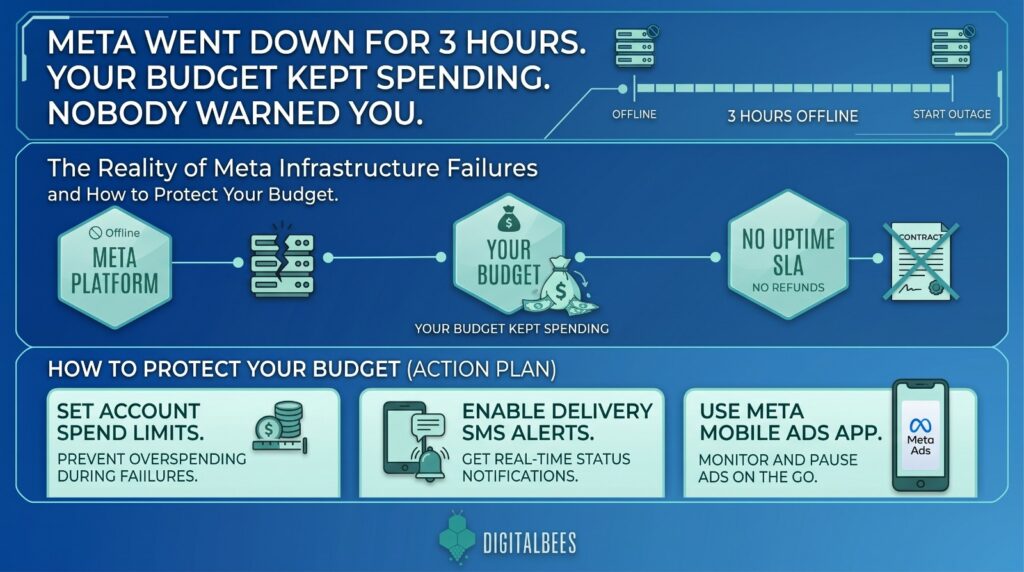
Meta’s platform collapsed. Over 100,000 outage reports flooded in. Ads Manager went dark. Instagram was inaccessible. And yet — campaigns kept spending. Some advertisers woke up to daily budgets blown ten times over. When they filed support tickets, the response was clinical: “no irregular activity detected.” No refund. Case closed.
This is not an edge case. This is what spending on Meta infrastructure looks like when things go wrong. And if you run paid ads on Meta, this is a conversation you need to have before the next outage — not after. If you’re unsure whether your current paid advertising setup is built to handle platform disruptions, this blog covers exactly what to look for.
Meta Has No SLA. Google Does. That Difference Is Costing You.
Most advertisers don’t realise there is a fundamental contractual difference between the two major ad platforms. Google publishes a written 99.9% uptime guarantee for advertisers. If Google’s infrastructure fails, there is a documented framework for what happens next. Meta offers nothing equivalent. No uptime commitment. No SLA. No compensation framework. You are running your business on infrastructure that owes you nothing when it fails.
This was not an isolated incident either. Meta averages three to seven platform disruptions per month. Some outages have run for multiple days. Others have hit in the middle of the night, during peak sale periods, during campaign launches. This is the operating environment your budget lives in — and most advertisers have never stopped to audit what that actually means for their business.
Real-world scenario:
Picture a D2C skincare brand running a product launch campaign — creative signed off, budget approved, team briefed. The campaign goes live. Hours in, Meta goes down. The founder can’t access Ads Manager to check performance. By the time the platform comes back up:
- ₹40,000 has been spent with no visibility into delivery quality
- The launch window — a narrow 48-hour push — has been partially consumed by platform noise
- There is no mechanism to claim a refund or even formally flag the disruption
If the same scenario played out on Google, the advertiser would have a written SLA to reference. On Meta, there is nothing. That is not a minor operational detail. That is a structural risk every Meta advertiser is carrying — and one that a properly structured performance marketing engagement should account for from day one.
Campaigns Spending Through an Outage Is a Known Behaviour — Not a Glitch
The most unsettling detail from this outage was not the downtime itself. It was that budgets kept spending while the platform was completely inaccessible. Advertisers couldn’t pause campaigns, couldn’t adjust bids, couldn’t monitor delivery — and Meta’s systems kept drawing from their accounts regardless.
This happens because ad delivery infrastructure and the user-facing Ads Manager are separate systems. When the front end goes down, the delivery engine often keeps running. This is by design, not by accident. Meta’s delivery system is built to be resilient — which is good for reach, but works against you when you need to intervene.
Real-world scenario:
A performance marketing manager at an e-commerce brand sets a ₹5,000 daily budget across three campaigns. During an outage, she notices traffic on the site drops but her ad account shows delivery as active. She tries to pause campaigns — Ads Manager won’t load. By the time access is restored:
- All three campaigns have overspent against their daily caps
- One campaign served the bulk of its impressions during a window of near-zero site traffic
- ROAS for the day is unsalvageable
The key things that made this worse:
- No account-level spend limit was set — only campaign-level budgets
- No automated rule was active to pause on overspend
- The mobile app was not installed, which stayed functional during the outage
Each of these was a fixable gap. None of them felt urgent until the outage happened. This is precisely why a thorough ad account audit — covering structure, tracking, and safeguards — is not optional for any brand spending meaningfully on paid channels.
Your First Line of Defence: Account-Level Spend Limits
The most underused setting in Meta Ads Manager is the account-level spend limit. Unlike campaign budgets, this is an absolute ceiling on what your account can spend across all campaigns within a billing cycle. It does not pause campaigns — but it stops spend dead once the threshold is hit. Think of it as a circuit breaker that sits above everything else in your account.
Most advertisers set campaign-level budgets and assume that is sufficient protection. It is not. During a system anomaly, delivery can behave erratically across multiple campaigns simultaneously — and campaign-level caps are not designed to account for that kind of cascading behaviour.
Real-world scenario:
An agency managing a mid-size fashion brand had campaign budgets set at ₹3,000 per day across six active campaigns. During a platform disruption, three campaigns overspent simultaneously — each within its own “limit” but collectively blowing the intended daily total by 2x. Because there was no account-level cap, nothing stopped it.
After the incident, the agency put the following in place:
- An account-level spend limit set at 110% of the intended monthly budget
- A review of all active campaigns to ensure daily budgets reflected actual intent
- A shared internal checklist for what to verify before scaling any account
The account-level limit alone would have capped the damage. It takes under two minutes to set. Most accounts don’t have one. If you want an expert eye on your account structure before the next disruption, Digital Bees offers a free Google Ads and Meta Ads audit — no commitment required.
Platform Risk Is Part of Your Media Strategy — Treat It That Way
The instinct after an outage is to look for an immediate fix — tighten the budget, set an alert, move on. The more useful instinct is to ask what this reveals about how your media budget is structured at a strategic level. Single-platform dependency is a business risk, not just an operational inconvenience. When one platform accounts for the majority of your paid acquisition and that platform goes down, your pipeline goes with it.
This does not mean abandoning Meta. Meta remains one of the most powerful paid acquisition channels available, particularly for B2C brands. It means building a structure that does not collapse when Meta does.
The brands that weathered this outage best were not the ones with the biggest budgets. They were the ones with the most structurally resilient media plans. Building that kind of resilience also extends beyond paid media — organic search traffic through SEO and AEO means your brand continues to capture high-intent demand even when your paid channels are inaccessible. It is the channel that keeps working when everything else goes dark.
Your ads not delivering for three hours is inconvenient. Your budget spending through it without your knowledge is a business problem. The infrastructure fixes covered here are not complicated — account-level spend limits, layered delivery alerts, mobile app access, and a diversified media structure. None of them require significant time or budget to implement.
The cost of ignoring them, however, shows up exactly when you can least afford it.
At Digital Bees, we audit platform risk before we touch a client’s ads — because the most expensive mistakes in paid media are usually structural, not creative. Book a free audit with Digital Bees 🐝